
AI in Consulting: How Artificial Intelligence is Reshaping the Industry
How is Consulting Changing Around AI?
There is no doubt that AI is becoming an integral part of society, being employed in both the personal and professional spheres. With this in mind, it is important to consider how AI will reshape the consulting industry and our careers.
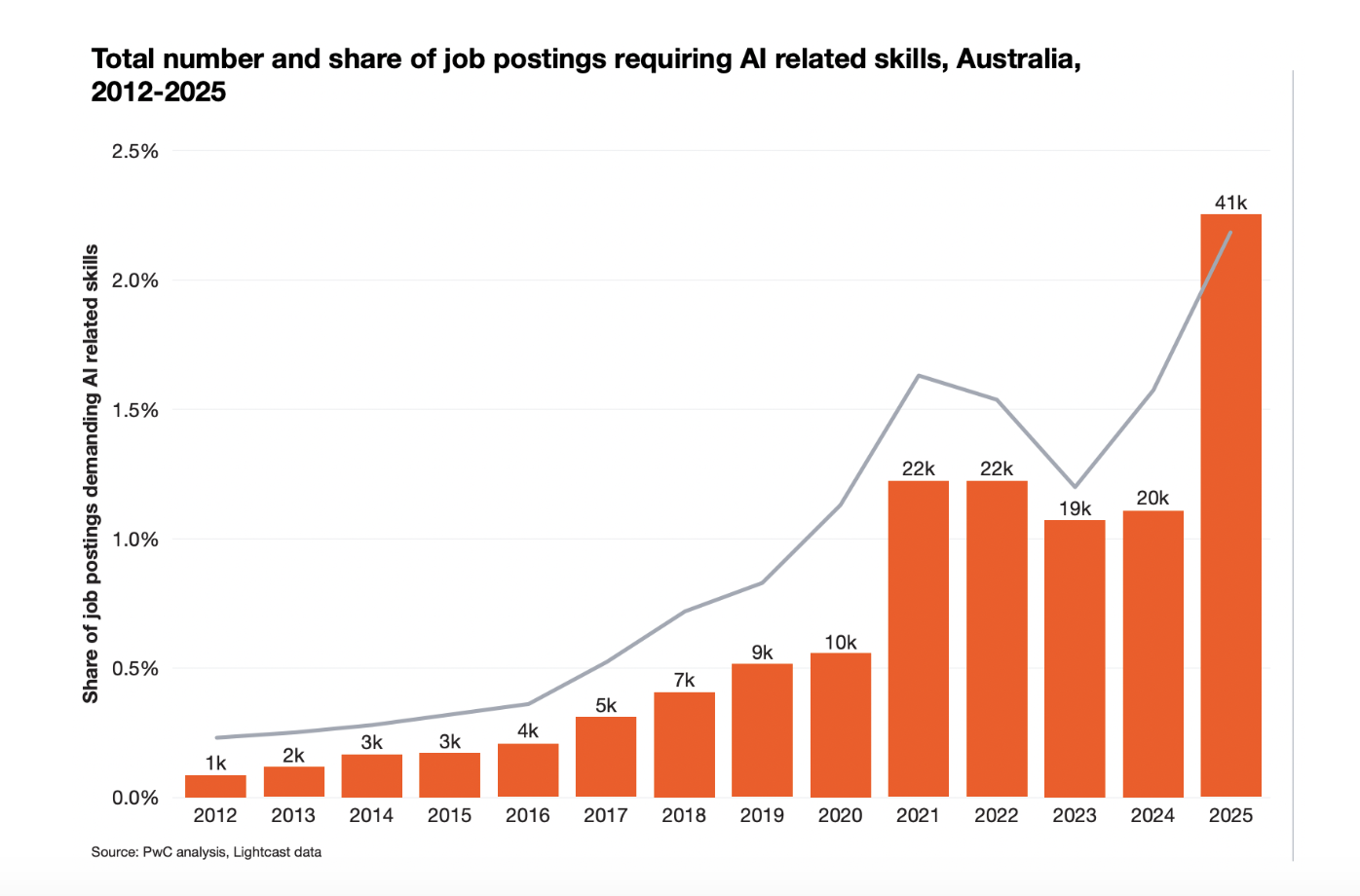
PwC’s 2026 AI Jobs Barometer perfectly illustrates this importance, with the total share of job postings in Australia requiring AI-related skills rising at an increasing rate since 2012.
Total number and share of job postings requiring AI related skills, Australia, 2012-2025
The consulting industry is undergoing a critical transition from the digital age, characterised by automation platforms and cloud systems, to a world with AI. Over the last 10 years, this has been revolutionising consulting, increasing efficiency, resilience, compliance and growth. However, clients’ expectations have been rising, demanding rapid and highly customised recommendations to their challenges. This has been putting pressure on consultants and exposing the limits of the digital age.
And so the age of AI began, specifically the emergence of generative and agentic AI systems, in consulting. AI has expanded consultants’ abilities with generative AI helping to design new scenarios and propose hypotheses, and Agentic AI helping with scenario interpretations. Together, they allow consultants and clients to exchange data and ideas in real-time.
However, the introduction of AI into the consulting industry has been met with mixed opinions. On one hand, some believe AI will render consultants obsolete. On the other hand, some believe it will make consultants more indispensable.
So what are the drawbacks and benefits of AI in consulting?
Concerns of AI in Consulting
The biggest concerns for job seekers and clients when it comes to AI being integrated into consulting are job reductions and ethical concerns, while concerns for consulting firms lie in the cost to adopt AI.
Job reductions
Clients have been increasingly using AI tools to generate initial diagnoses before conferring with consultants for deeper expertise. This has made some consultants, specifically generalist consultants and junior staff, more vulnerable to AI-empowered clients.
In the past, top consulting firms have traditionally hired generalist consultants for their analytical ability over sector expertise. However, this field of work is becoming increasingly overlapped with tasks that generative AI can perform. Hence, mundane, repetitive tasks will be delegated to AI tools, displacing more generalist and junior consultants.
Privacy and ethical concerns
A major area of concern for clients is the ethics of using AI in the industry. AI generally requires large amounts of data, which can raise privacy and security concerns. This may lead clients to be reluctant to share sensitive information with consultants if the firm lacks a strong security infrastructure.
Overreliance on AI in consulting, especially among less experienced consultants, may erode independent and creative thinking skills. This could lead to important factors or insights being overlooked, as AI cannot provide the experience, intuition, and judgment humans have to offer.
Costs to consulting firms
Consulting firms will need to invest in reskilling and upskilling programs to ensure their employees are equipped with proficient AI-related skills. Further secure AI tools will need to be integrated into the firm's resources and continually monitored to ensure security concerns are addressed.
Additionally, with AI reviewing and writing documents in a matter of minutes, the traditional billing model of time-based pricing no longer reflects value delivered. McKinsey is one such company that has identified the need for a switch in pricing strategy. The firm has spent more than two years overhauling the way partners are paid, moving away from its old billable hours model. McKinsey has now transitioned around a third of its work to performance-based fees.
Benefits to AI consulting
AI, of course, has many benefits, especially for consulting firms. This includes improved efficiency and productivity. For smaller firms, AI grants them the opportunity to scale up their project size. From a client’s perspective, AI can help tailor responses to their situations, providing a more personalised and satisfying experience.
Improved Efficiency in Firms
AI can be integrated into several key areas in consulting firms. These include:
Automation of routine tasks
Improving decision-making processes
Optimising supply chain operations.
Repetitive, high-volume tasks such as these are completed in record time and with high accuracy thanks to AI tools.
Consulting firms such as Deloitte and EY have been successful in their adoption of AI. According to Deloitte’s due diligence, its AI automated document review has resulted in a reduction of around 50% in time spent analysing invoices, financials, board meeting notes, and legal contracts. EY has developed its own in-house Robotic Process Automation (RPA) system that helps automate routine processes such as audits. EY has claimed that the system has allowed the company to deliver more accurate and efficient audits to clients.
These are just some of the ways consulting firms are using AI to improve efficiency through automation of routine tasks.
Scale Opportunities for Smaller Firms
Building on the automation of routine tasks, Generative and Agentic AI systems can allow smaller firms to take on more projects and on a bigger scale. Low budget and limited resources are the biggest challenges small firms face. However, the introduction of AI tools can reduce operational costs and optimise the use of resources.
The Management Consultancies Association estimates that smaller firms are experiencing growth rates of up to 50% with the help of AI, allowing them to compete with larger rivals.
More Personalised Responses for Clients
AI’s benefits are not limited only to firms; clients can expect more personalised insights into their challenges and ideas. AI helps consultants learn more about unexplored industries, niches and opportunities. By expanding consultants’ knowledge, AI assists in providing clients with customised offerings, matching specific needs and preferences.
For example, AI can help:
Marketing Consultancy - create personalised customer experiences and marketing plans from consumer data
HR Consultancy - create staff training plans tailored to individuals’ skill gaps and goals
The Future of AI in Consulting
A big question all of us are concerned with is, “Will AI remove the need for humans in consulting?”
In short, no!
Replacing humans with AI entirely seems rather difficult, with a 2023 study finding the success rate of AI projects to only be 15%. Further, there is scepticism about AI replacing white-collar professionals, so the practical application of AI will remain limited to providing input to individual decision-making processes or tasks.
While AI demonstrates exceptional ability to process large scales of information, it cannot replicate human qualities, including creativity, judgment, empathy and trust that define successful consulting.
How do I prepare myself?
To start, understanding how to use AI responsibly and accessing university resources will help you navigate the dos and don’ts of AI usage. More on using AI responsibly will be covered in next week’s edition, so stay tuned!
